Beyond chat charts to warehouse-grade PA.
Julius AI helps teams ask questions and visualize fast. Mitzu delivers trusted agentic analytics on your event lake—with governed definitions, monitoring, and workflows built for product orgs.
The Difference
Conversational vs Warehouse-native

Chat & charts
Quick exploratory analysis

Trusted Agentic Analytics
Semantic layer on events
Purpose-built for product analytics at scale
Trusted by companies worldwide












When conversational AI is not enough
Semantic source of truth
Metrics anchored to your warehouse definitions
Query freshness
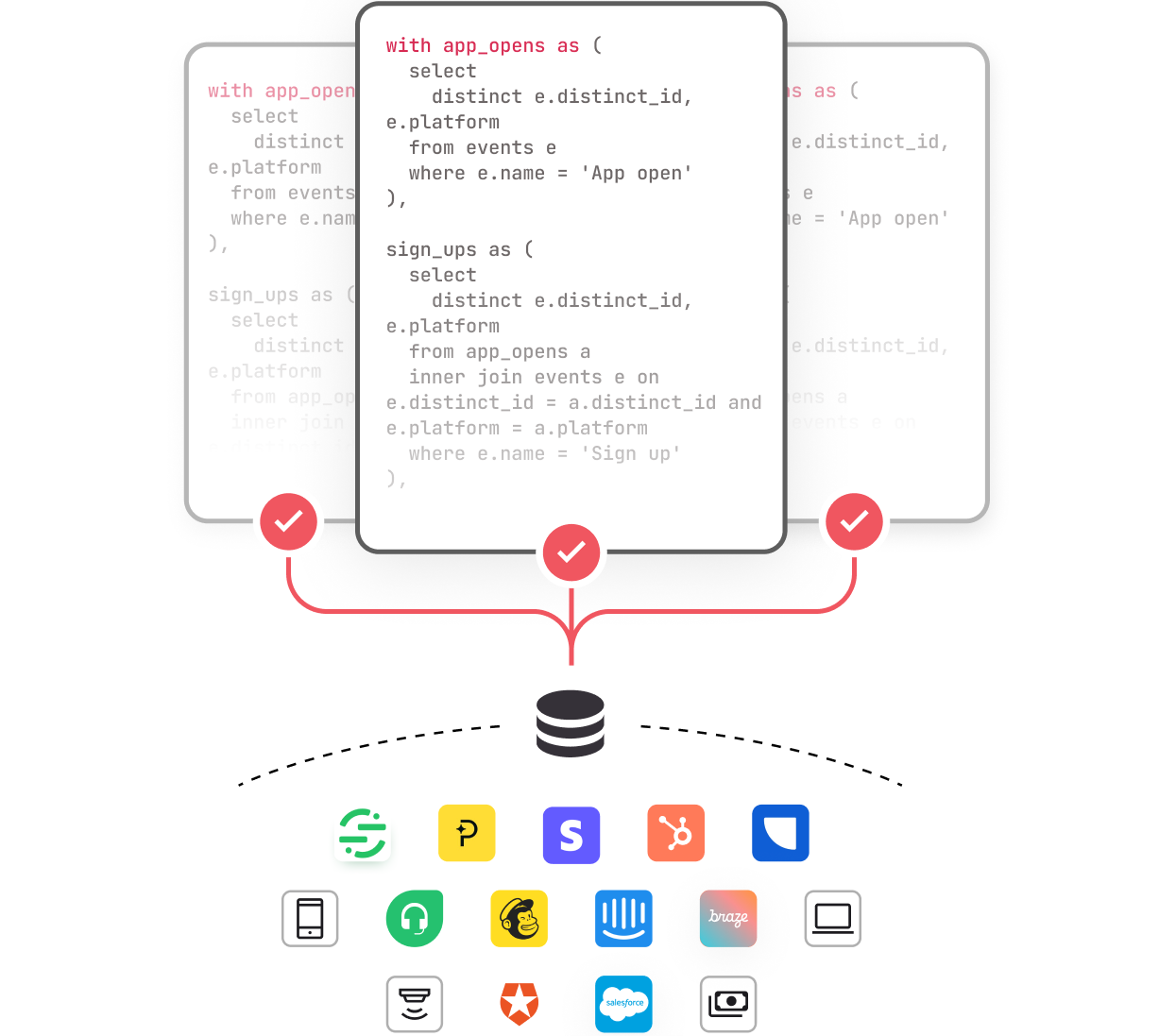
Analyze data where pipelines already land
Product analytics depth
Funnels, retention, journeys as core workflows
Operationalize product analytics
Conversational tools help individuals move fast. Mitzu helps organizations run funnels, retention, and monitoring on the same governed warehouse definitions—so insights compound instead of resetting every sprint.
Conversational analysis vs agentic product analytics
- Not a dedicated semantic layer product
- Methodology must be validated by your team
 mitzu
mitzuAgentic semantic layer
AI agent
“Active users last week?”
Semantic layerData warehouse
Snowflake · BigQuery · Databricks
- Grounded in definitions your team controls
- Live queries on trusted warehouse tables
- Product analytics workflows built-in
Feature-by-feature comparison
| Features | Mitzu | Julius AI |
|---|---|---|
| Architecture & Data | ||
Primary focus What the product optimizes for | Trusted agentic product analytics | Conversational analysis & visualization |
Warehouse-native execution First-class queries on your tables | Varies | |
Semantic layer / governed metrics Shared definitions across teams | Limited | |
Product analytics workflows Funnels, retention, journeys as products | Assisted / build-your-own | |
Proactive monitoring KPI and anomaly workflows | ||
| Product Analytics Features | ||
Funnel analysis Multi-step conversion modeling | Prompt-led | |
Retention & cohorts Cohort windows and identity-aware logic | Prompt-led | |
Segmentation Reusable segments for teams | Session-based | |
User / account journeys Path analysis across entities | Prompt-led | |
Executive-ready dashboards Operational views without rewriting prompts | Manual | |
Deep research workflows Autonomous multi-step analysis | Varies | |
| Trust & Governance | ||
Reviewable SQL Transparency into computations | Varies | |
Align with BI definitions Same metrics as engineering definitions | Limited | |
Role-based operational use PM, growth, and data team collaboration | Individual-first | |
| Implementation | ||
Best for Ideal customer profile | Product & data teams at scale | Rapid exploration & lean teams |
Self-hosted deployment Run inside your infrastructure | ||
Time to first warehouse insights Connect and standardize PA | Hours | Minutes (exploration) |
| Privacy & Security | ||
Data residency posture Where analytical compute runs | Queries your warehouse; optional self-host | Vendor cloud (verify DPA / data residency) |
Enterprise agreements Procurement for analytics platform | ||
Fast charts are not a semantic layer.
Conversational tools shine when you need a quick visual. Product organizations also need stable definitions so every team cites the same funnel, retention window, and identity rules on warehouse data.
- Reduce metric debates in roadmap meetings
- Keep growth and PM workflows aligned
- Operationalize monitoring—not only one-off charts
Warehouse
Mitzu
Tie analytics to how engineering defines truth.
Mitzu is designed for teams that already invest in governed metrics and warehouse modeling. That keeps dashboards, agents, and BI aligned instead of inventing parallel definitions in chat.
- Inherit dimensions from trusted marts
- Improve audit readiness for KPI reviews
- Shorten time from question to trusted answer
Product analytics is a team sport.
Mitzu supports shared dashboards, monitoring, and agentic workflows so insights scale beyond a single analyst’s chat session.
- Executive summaries anchored to the same metrics
- Cross-functional alignment on definitions
- Less redundant SQL rewritten in threads
Individual exploration
Org-wide product analytics
Scale collaboration—not only individual threads.
Add Mitzu alongside Julius AI.
Connect the warehouse
Use the same Snowflake, BigQuery, or Databricks tables your pipelines already populate.
Define semantics
Map events, users, and revenue so funnels and cohorts match your business logic.
Roll out to the org
Ship dashboards, alerts, and agentic analyses without losing conversational tools for edge cases.
Frequently asked questions
Ready for warehouse-native product analytics?
Give product, growth, and data teams trusted metrics—with agentic workflows built on your semantic layer.