TL;DR
A ranked comparison of AI analytics agents for startup and enterprise data warehouses — evaluated on fast setup, warehouse-native operation, and autonomous analysis depth. The category of AI analytics agents for data warehouses has matured fast.
The category of AI analytics agents for data warehouses has matured fast. The distinction that matters now is not whether a tool has an AI chat interface — most do — but whether it can run autonomous analysis workflows directly on your warehouse, with methodology you can trust and setup that takes days rather than months. This guide ranks the leading tools on those three criteria and is written for data and analytics leaders who already have a warehouse and want to know which agent will actually get used. If you're still scoping the category, start with what agentic analytics means in practice.
One hard prerequisite before reading: every tool on this list assumes your event data lives in a cloud data warehouse — Snowflake, BigQuery, Databricks, Redshift, ClickHouse, or equivalent. Tools that require you to copy events into a separate vendor store are out of scope here. If you're evaluating the warehouse-first architecture more broadly, see warehouse-native analytics: benefits and how it works.
Evaluation criteria
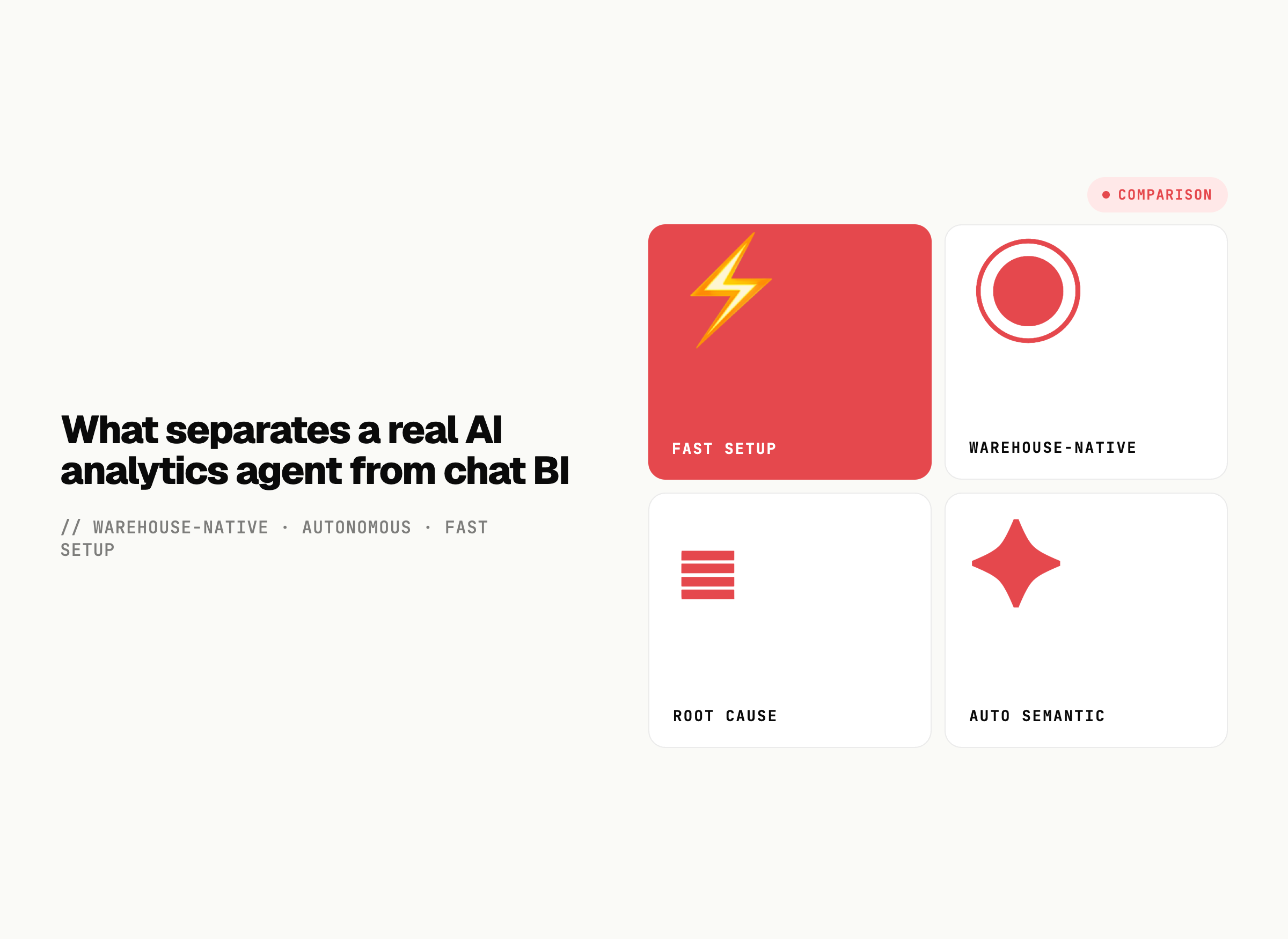
Each tool is scored across three criteria that consistently drive adoption success for analytics leaders:
- Fast setup: How quickly can a data analyst connect the warehouse, configure a semantic context, and hand off to business users? Setup time is frequently the decision point for startups and lean analytics teams.
- Warehouse-native operation: Does the agent query the warehouse directly without copying data into a third-party store? This drives compliance posture, per-event cost avoidance, and the ability to join behavioural events with CRM, billing, and support data already in the warehouse.
- Autonomous analysis depth: Can the agent investigate a question — root cause, impact analysis, multi-step funnel and retention breakdowns — without the analyst building the query by hand? Descriptive metric lookup is table stakes; autonomous multi-step investigation is the differentiator.
Quick comparison: AI analytics agents for data warehouses
| Tool | Warehouse-native | Setup speed | Autonomous analysis depth | Best fit |
|---|---|---|---|---|
| Mitzu | Yes — direct query, no copy | Hours to days | High — funnel, retention, root cause, impact analysis | Startups and growth-stage teams with warehouse and event data |
| ThoughtSpot | Yes — live warehouse connections | Weeks (semantic model required) | Medium — search-driven BI, strong metric lookup | Enterprise BI programs with dedicated data engineering |
| Omni | Yes — direct warehouse model | Days to weeks | Medium — analyst-driven exploration, AI assist | Teams scaling BI with analyst oversight |
| Sigma | Yes — live warehouse queries | Days to weeks | Medium — spreadsheet-style exploration | Business users comfortable with spreadsheet logic |
| Metabase | Yes — direct warehouse connections | Hours to days | Low-medium — Q&A, basic AI assist | Teams needing fast lightweight dashboards |
| GoodData | Yes — composable analytics | Weeks | Medium — governed metric layer with AI query | Enterprises with complex metric governance requirements |
Ranked list: tool-by-tool breakdown
1. Mitzu — agentic product analytics on your warehouse
Mitzu is an agentic product analytics platform built specifically for warehouse-native event data. The Configuration Agent scans your warehouse, identifies event tables, maps identifiers and dimension properties, and builds a semantic layer without hand-authored YAML — typically in hours. The Analytics Agent then answers behavioural questions through natural-language conversation: funnels, retention, segmentation, journeys, and multi-step root-cause investigations. The agent does not write SQL. A deterministic query engine turns analysis specifications into SQL using product analytics methodology developed over years — same specification, same SQL, every time. This is the trust mechanism that distinguishes Mitzu from tools that route natural language through an LLM to a SQL generation step.
For data warehouse automation specifically: Mitzu connects to Snowflake, BigQuery, Databricks, Redshift, and ClickHouse. It queries your warehouse directly — no event data leaves for a third-party store. Behavioural events join naturally with billing, CRM, and support tables already modelled in the warehouse. For teams on dbt, Mitzu reads dbt-modelled tables the same way it reads raw event streams. Adjacent users — PMs, marketing, growth leads — reach the agent through Slack or through an MCP-compatible agent, without opening a separate analytics UI. See the enterprise evaluation guide for governance and security considerations.
- Fast setup: Configuration Agent automates semantic layer setup from warehouse scan — analysts review and adjust rather than build from scratch. Most teams are live in hours to a few days.
- Warehouse-native: Direct query against Snowflake, BigQuery, Databricks, Redshift, ClickHouse. No data copy, no per-event pricing, compliance-friendly for fintech and EU-resident data teams.
- Autonomous analysis depth: Handles diagnostic questions — root cause, impact analysis, hypothesis validation — in a single prompt. The agent fans out into multiple tool calls and returns a synthesised result.
- Limitation: The ICP is teams with event data already in a warehouse. Teams whose product analytics is fully locked in a third-party tool and not moving to a warehouse are not the right fit.
2. ThoughtSpot — enterprise search-driven BI with AI
ThoughtSpot is a mature enterprise platform with live warehouse connectivity and a search-first interface. ThoughtSpot Sage extends that interface with LLM-powered natural language — the agent generates queries against ThoughtSpot's semantic layer (Worksheets and tables) and returns chart or table results. It is well-suited to organisations that have already invested in centralised BI programs and want to extend those programs with conversational access, rather than rebuild the analytics operating model from scratch.
- Fast setup: Requires a hand-built semantic model (Worksheets) before the AI agent can answer reliably. This is meaningful data engineering work — plan for weeks, not hours.
- Warehouse-native: Strong — ThoughtSpot live query connects to major warehouses without copying data.
- Autonomous analysis depth: Strong on metric lookup and search-driven BI; the AI layer is grounded in the BI semantic model rather than specialised for product analytics behavioural queries like funnels and retention.
- Limitation: Lighter setups and startup teams may find the implementation investment heavy relative to the use case.
3. Omni — governed BI with AI-assisted exploration
Omni is a BI platform built around a shared semantic model that analysts curate and business users consume through drag-and-drop and AI-assisted query. It sits between traditional BI and agentic analytics: the AI can suggest breakdowns, generate SQL explorations, and surface relevant metrics, but complex multi-step behavioural investigations still require analyst involvement. Omni queries the warehouse directly and does not copy data.
- Fast setup: Faster than legacy BI tools — the model layer is built in Omni's interface rather than in LookML. Expect days to a couple of weeks depending on model complexity.
- Warehouse-native: Yes — direct warehouse connections, consistent with modern BI standards.
- Autonomous analysis depth: Medium — AI assist accelerates analyst-led exploration but doesn't autonomously run multi-step diagnostic investigations from a single natural-language prompt.
- Limitation: Teams expecting the AI to investigate questions end-to-end without analyst involvement will still need to build exploration workflows manually.
4. Sigma — spreadsheet-style analytics on the warehouse
Sigma runs live warehouse queries through a spreadsheet-like interface, making it accessible to business users who think in rows and columns. Its AI features provide formula suggestions and natural-language query assistance on top of that interface. For teams where the primary self-service persona is a business analyst or operations user comfortable with spreadsheet logic, Sigma reduces the barrier to warehouse access without requiring SQL skills.
- Fast setup: Reasonably fast for BI use cases — connection and initial workbook setup can happen in days.
- Warehouse-native: Yes — Sigma pushes all computation to the warehouse, consistent with warehouse-native architecture principles.
- Autonomous analysis depth: Lower than agentic-first tools — the interface is exploration-driven rather than investigation-driven. Complex behavioural queries like funnels and retention require analyst-built workbooks.
- Limitation: For data warehouse automation and autonomous analytics workflows, Sigma's spreadsheet paradigm adds friction compared with agent-first tools.
5. Metabase — lightweight dashboards with basic AI Q&A
Metabase is a widely-used open-source BI tool with a fast-setup reputation. Connecting to a warehouse takes minutes; initial dashboards can be live the same day. Its AI layer handles straightforward natural-language questions — what was revenue last week, how many sign-ups in March — and generates SQL queries to answer them. For startup data warehouses where the primary requirement is accessible dashboards for business teams, Metabase offers the lowest barrier to entry on this list.
- Fast setup: Among the fastest on this list — especially in open-source self-hosted configuration. Warehouse connection and first dashboards in hours.
- Warehouse-native: Yes — Metabase queries the warehouse directly through standard connectors.
- Autonomous analysis depth: Low to medium — the AI Q&A handles descriptive questions well but doesn't autonomously run diagnostic investigations or product analytics workflows like funnel or retention analysis.
- Limitation: Teams that need autonomous analytics — root cause investigation, multi-step cohort analysis, warehouse data automation workflows — will outgrow Metabase's AI layer quickly.
6. GoodData — governed metric layer with AI query
GoodData is an enterprise analytics platform with a composable metrics layer and an embedded analytics model. Its AI capabilities allow natural-language queries against a governed semantic model. It is positioned for enterprises that need consistent metric definitions across business units and want to expose those definitions through embedded analytics or AI-assisted query. Setup involves building and governing the metrics layer, which is a data engineering investment.
- Fast setup: Heavy — the governed metric layer is the product; building it requires significant data engineering time.
- Warehouse-native: Yes — GoodData connects to cloud warehouses and pushes computation accordingly.
- Autonomous analysis depth: Medium — AI queries the governed metric layer well; autonomously investigating behavioural questions or running diagnostic root-cause analysis is not the primary use case.
- Limitation: For startup data warehouses or lean analytics teams, the governance investment required upfront makes GoodData a better fit for enterprises already running mature analytics programs.
Capability comparison: what each agent can answer
The following table maps representative analytics questions to what each tool handles reliably from a single natural-language prompt. ✅ = works as expected. ❌ = either doesn't work or requires substantial analyst effort beyond the prompt.
| Question | Mitzu | ThoughtSpot | Omni | Sigma | Metabase | GoodData |
|---|---|---|---|---|---|---|
| "What was DAU last week?" | ✅ | ✅ | ✅ | ✅ | ✅ | ✅ |
| "Signup-to-activation funnel by channel, 7-day window" | ✅ methodology in engine | ❌ BI-shaped semantic layer | ❌ analyst must build | ❌ analyst must build | ❌ | ❌ |
| "Why did week-2 retention drop in November?" | ✅ agent investigates | ❌ returns metric, not investigation | ❌ analyst-led | ❌ analyst-led | ❌ | ❌ |
| "Did the new pricing page move trial-to-paid?" | ✅ | ❌ attribution fragile | ❌ analyst-led | ❌ analyst-led | ❌ | ❌ |
| "Feature usage for enterprise accounts joined with NPS scores" | ✅ warehouse-native joins | ✅ if modelled | ✅ if modelled | ✅ if modelled | ❌ no warehouse join | ✅ if modelled |
| "LTV by acquisition channel, top three channels" | ✅ warehouse-native joins | ✅ if billing modelled | ✅ if billing modelled | ✅ if billing modelled | ❌ | ✅ if modelled |
| "Export users who started checkout but didn't finish" | ✅ | ❌ | ❌ | ❌ | ❌ | ❌ |
How to choose: startup vs enterprise data warehouses?
The decision splits cleanly along two axes: setup investment tolerance and required analysis depth.
- Startup data warehouses with lean analytics teams: Prioritise fast setup and autonomous analysis depth — your analyst shouldn't be rebuilding queries for every ad-hoc request. Mitzu and Metabase offer the fastest time-to-first-insight. Mitzu's edge is analysis depth; Metabase's edge is dashboard simplicity.
- Growth-stage teams with a dbt model and event data: Mitzu's Configuration Agent reads dbt-modelled tables and raw event streams without distinction. If you're already on dbt, setup is particularly fast and the semantic layer extends naturally from what's already modelled.
- Enterprise data warehouses with existing BI programs: ThoughtSpot and GoodData are designed for this. If the goal is to extend an existing metric governance program with AI query access, not to rebuild the analytics operating model, these tools minimise disruption.
- Teams needing autonomous analytics workflows — not just AI-assisted dashboards: Only tools with agent-first architectures and product-analytics methodology built in will deliver autonomous multi-step analysis. This is currently the clearest differentiator for Mitzu in this list.
For a broader view of how agentic analytics platforms stack up on governance, trust, and security criteria relevant to enterprise teams, see the agentic analytics platforms compared guide. For the full enterprise evaluation framework, see evaluating AI analytics agents for enterprise data.
Setup time expectations
Fast setup analytics is a meaningful differentiator because data teams are small and the opportunity cost of a long implementation is high. Here is a realistic breakdown:
| Tool | Typical time to first reliable answers | What drives setup time |
|---|---|---|
| Mitzu | Hours to 2 days | Warehouse connection + Configuration Agent scan + analyst review |
| Metabase | Hours to 1 day | Warehouse connection + dashboard build; AI Q&A quality depends on schema clarity |
| Omni | 2–5 days | Semantic model authoring in Omni's interface |
| Sigma | 2–5 days | Workbook design and data model connection |
| ThoughtSpot | 2–6 weeks | Worksheet and semantic model build; enablement programs for large orgs |
| GoodData | 4–8 weeks | Composable metrics layer design and governance setup |
FAQ
What is an AI analytics agent for a data warehouse?
An AI analytics agent for a data warehouse is a system that answers analytical questions through natural-language conversation, querying the warehouse directly. The better ones don't just generate SQL from the prompt — they assemble structured analysis specifications (funnels, retention windows, cohort definitions) and translate those into queries using product analytics methodology. This is the distinction between a text-to-SQL tool and an agentic analytics platform.
What makes warehouse-native operation important for AI analytics agents?
Warehouse-native operation means the agent queries your data in place — no copy to a third-party store. This matters for three reasons: compliance (data doesn't leave your perimeter), cost (no per-event pricing on top of warehouse compute), and data richness (behavioural events can be joined natively with billing, CRM, and support data already in the warehouse). Tools that require event ingestion into a separate system can only answer questions about the data in that system.
How do AI analytics agents handle startup vs enterprise data warehouses differently?
Startups typically need fast setup, low configuration overhead, and agents that can answer a wide range of ad-hoc questions without a hand-built semantic model. Enterprise data warehouses tend to have more complex governance requirements — metric consistency, access controls, audit trails — and the tools that serve them (ThoughtSpot, GoodData) invest more in that governance layer at the cost of setup time. The right choice depends on whether your team is optimising for speed-to-insight or for governance depth.
Can AI analytics agents answer root-cause questions, not just metric lookups?
Most AI analytics tools can answer descriptive questions — what was the number, how did it compare. Fewer can autonomously investigate why a metric changed. Root-cause analysis requires the agent to fan out into multiple sub-queries (funnel breakdowns by segment, cohort comparisons, time-sliced retention) and synthesise a diagnostic answer. This is the primary capability gap between search-driven BI tools and purpose-built agentic product analytics platforms. For a deeper look at how this investigation works in practice, see how AI agents query your data warehouse.
What is the difference between autonomous analytics and AI-assisted BI?
AI-assisted BI adds natural-language query or formula suggestions on top of an existing analyst-built dashboard or model. The analyst still owns the investigation; the AI reduces friction. Autonomous analytics means the agent owns the investigation from prompt to result — it selects the right analysis type, runs the queries, and returns a synthesised finding. For data warehouse automation use cases — answering recurring business questions without analyst involvement — autonomous analytics is the relevant capability.
Authoritative references
- ThoughtSpot documentation
- Omni documentation
- Sigma Computing documentation
- Metabase documentation
- GoodData documentation
- Snowflake documentation
- Google BigQuery documentation
If your team has event data in a warehouse and is evaluating AI analytics agents for autonomous product analytics workflows, book a Mitzu demo or explore the Analytics Agent and product analytics capabilities.