TL;DR
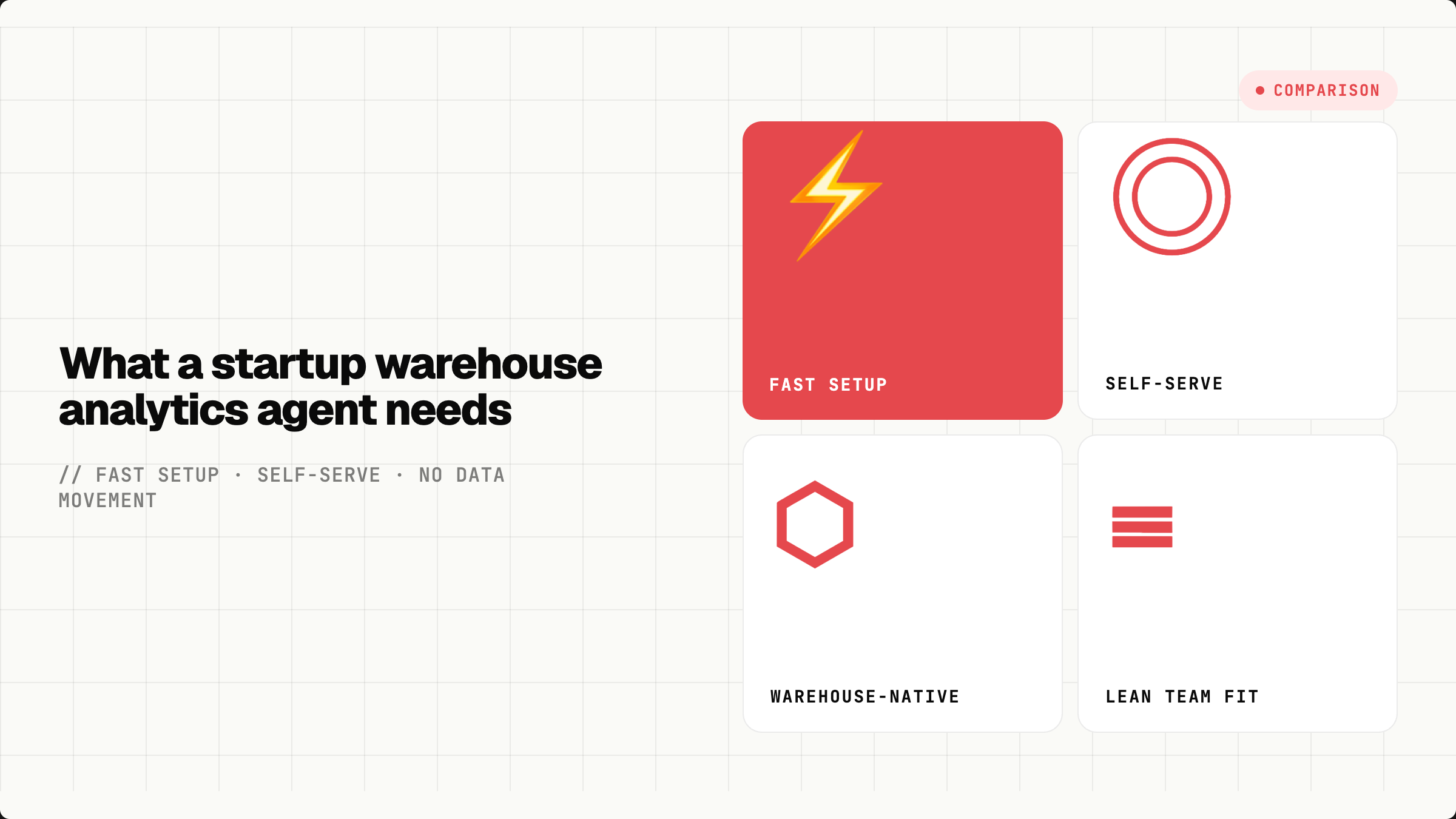
A skimmable comparison of AI analytics agents by warehouse integration speed, self-service depth, and fit for lean startup data teams. Most AI analytics agents were designed for teams with six-month implementation budgets and dedicated semantic-layer engineers.
Most AI analytics agents were designed for teams with six-month implementation budgets and dedicated semantic-layer engineers. Startups don't have either.
This guide compares five AI analytics agents on the criteria that matter for a lean data team: how fast you get from a warehouse connection to a reliable first answer, how much SQL work the analyst still has to do, and whether business stakeholders can self-serve without opening a ticket.
One prerequisite applies to every tool on this list: a modern cloud data warehouse — Snowflake, BigQuery, Databricks, Redshift, or ClickHouse — with event or behavioral data already in it. If your data isn't in a warehouse yet, no agent on this list will shortcut that gap.
How these agents compare at a glance?
| Tool | Category | Warehouse integration | Setup time | Self-serve for non-analysts | Methodology guard-rails |
|---|---|---|---|---|---|
| Mitzu | Agentic product analytics | Snowflake, BigQuery, Databricks, Redshift, ClickHouse, PostgreSQL, Athena, Trino | Under one hour | Yes — agent + Slack Agent | Deterministic query engine; agent doesn't write SQL |
| ThoughtSpot | AI-powered BI / text-to-SQL | Snowflake, BigQuery, Databricks, Redshift | Days to weeks (SpotIQ modeling) | Yes — SpotIQ, Sage | LLM generates SQL; SpotIQ adds guardrails |
| Omni | BI with AI layer | Snowflake, BigQuery, Databricks, Redshift, DuckDB | Days (model layer required) | Partial — exploration UI, limited agent | Analyst-authored model layer required |
| Sigma | Cloud spreadsheet BI | Snowflake, BigQuery, Databricks, Redshift | Days (workbook setup) | Partial — spreadsheet UX, some AI assist | AI assists SQL writing; no methodology engine |
| GoodData | Embedded / headless BI | Snowflake, BigQuery, Databricks, Redshift | Weeks (MAQL metric model) | Yes — via AI chat on top of model | Model layer constrains AI; setup is engineering-heavy |
1. Mitzu — agentic product analytics built for startup speed
Best for: Startups with event data in a cloud warehouse that need funnels, retention, and behavioral analysis available to both analysts and non-technical stakeholders — fast.
Mitzu is an agentic product analytics platform that runs on your data warehouse and answers behavioral questions through natural-language conversation, without writing SQL. The key distinction: Mitzu's Analytics Agent doesn't write SQL from a prompt. It assembles an analysis specification — funnel steps, retention windows, cohort definitions — and a deterministic query engine turns that into SQL using product analytics methodology refined over years. Same specification, same SQL, same answer every time.
Setup is handled by the Configuration Agent. It scans your warehouse, identifies event and dimension tables, recognizes common schema patterns (Segment, Snowplow, Firebase, GA4, custom schemas), maps user identifiers, and builds a semantic layer specialised for product analytics. No YAML, no hand-authored metric models. Analysts review and adjust the output.
Most teams get from a warehouse connection to their first reliable answer in under an hour.
- Fastest warehouse-to-first-answer setup on this list — the Configuration Agent auto-builds the semantic layer.
- No data movement: events stay in your warehouse. Relevant for compliance, cost control, and teams already using dbt.
- Analysts and non-technical stakeholders (PMs, growth, leadership) can both reach the agent — in-app or via the Slack Agent.
- Funnels, retention, segmentation, and journeys are first-class methodology — not approximate SQL.
- Native joins to any warehouse data: billing, CRM, support tickets, anything already modelled.
- Requires an existing warehouse with event data — not a fit for pre-warehouse teams.
- Focused on behavioral and product analytics; not a general-purpose BI or financial reporting tool.
- Newer than the BI incumbents on this list; ecosystem integrations are growing.
Startup fit: Highest on this list. The Configuration Agent eliminates the weeks of semantic-layer work that blocks other tools from delivering value quickly. The Slack Agent means adoption doesn't depend on every stakeholder learning a new app.
2. ThoughtSpot — AI search and automated insights on your warehouse
Best for: Teams that already have a well-modeled data warehouse and want natural-language BI search with automated anomaly detection.
ThoughtSpot Sage layers a large language model over ThoughtSpot's SpotIQ engine, letting users ask questions in plain English and get charts without writing SQL. The LLM generates the query; SpotIQ provides guardrails through its data modeling layer. ThoughtSpot has a long track record in enterprise BI and solid warehouse connectivity.
- Mature AI search layer — Sage has been iterated for several years.
- SpotIQ provides automated insight detection on top of existing models.
- Strong connector ecosystem: Snowflake, BigQuery, Databricks, Redshift.
- Enterprise security and governance features if you're building for that direction.
- Setup requires building a ThoughtSpot data model (worksheets, joins, column descriptions) before Sage can answer reliably — typically days to weeks depending on warehouse complexity.
- LLM-generated SQL means methodology correctness depends on how well the model layer is defined.
- Product analytics methodology (funnels, retention windows, cohort time bucketing) isn't natively enforced — analysts have to model these correctly.
- Pricing and licensing are enterprise-oriented; can be a mismatch for early-stage teams.
Startup fit: Moderate. ThoughtSpot is a capable tool, but the modeling investment required before Sage becomes reliable is a real cost for lean teams. Better suited to startups that already have a ThoughtSpot-modeled layer or an analytics engineer with time to build one.
3. Omni — modern BI with an analyst-first AI layer
Best for: Startups that want collaborative BI exploration with AI assist, where analysts remain the primary authors of the model layer.
Omni is a cloud BI tool built for modern data stacks, with an AI layer that assists exploration and query drafting on top of an analyst-authored model. The model layer is designed to be more fluid than LookML — analysts can define and adjust it as they explore — but it still requires human authoring before AI answers become reliable for non-technical users.
- Exploration-first UX — well suited for analysts who want flexibility alongside structure.
- AI assists SQL drafting in context of the existing model; reduces boilerplate work.
- Git-backed model versioning is useful for teams already on dbt workflows.
- Broad warehouse connector support including DuckDB for local-first scenarios.
- Model layer requires analyst authoring before stakeholders can self-serve reliably.
- No auto-configuration: the semantic layer doesn't build itself from warehouse scans.
- Product analytics depth (funnels, retention cohorts, user journeys) is limited relative to dedicated product analytics tools.
- Business stakeholders still depend on analysts for net-new question types.
Startup fit: Good for analyst-centric teams that value BI flexibility and have bandwidth to maintain a model layer. Less suited to teams where the primary goal is PM and growth self-serve on behavioral data.
4. Sigma — spreadsheet-native analytics with warehouse reach
Best for: Teams where business stakeholders are already comfortable in spreadsheets and want warehouse data surfaced in a familiar UI.
Sigma surfaces warehouse data through a spreadsheet-style interface, making it accessible to users who find traditional BI tools unfamiliar. AI features assist with formula writing and query generation. The tradeoff is that depth of analysis — especially behavioral product analytics — is constrained by what the spreadsheet metaphor can express.
- Spreadsheet UX lowers adoption friction for business stakeholders unfamiliar with BI.
- Direct warehouse connectivity — no separate data warehouse or ETL layer.
- AI assist for formulas and calculated columns reduces analyst intervention on common tasks.
- Good for operational reporting and ad-hoc tabular exploration.
- Product analytics methodology (funnels with conversion windows, retention cohorts, behavioral segmentation) isn't a native strength.
- AI features assist SQL authoring rather than replacing it — analysts remain in the loop for complex questions.
- Workbook setup is required before stakeholders can explore reliably; not auto-configured.
- Spreadsheet metaphor can break down for large event datasets or complex behavioral queries.
Startup fit: Moderate. Strong choice if your stakeholders live in spreadsheets and need operational reporting. A weaker fit if the primary use case is behavioral product analytics — funnels, retention, user journeys — where you need methodology enforcement, not formula assistance.
5. GoodData — embedded and headless BI with AI on top
Best for: Startups building analytics into their own product (embedded analytics) or those with a data engineering team willing to invest in a formal metric model.
GoodData provides embedded and headless BI capabilities with an AI chat layer on top of its MAQL-powered semantic model. The AI's reliability is governed by how well the underlying metric model is defined. GoodData's strength is analytics that gets embedded into customer-facing products — a specific use case rather than internal self-serve analytics.
- Strong embedded analytics story — if you're building analytics into your own product, GoodData has the infrastructure for it.
- Headless BI API lets you compose analytics programmatically.
- AI chat is constrained by the semantic model, which limits methodology errors within the model's scope.
- Multi-tenant workspace model is useful for analytics-as-a-product scenarios.
- MAQL metric model requires significant upfront data engineering investment — typically weeks before AI answers are reliable.
- Not designed for internal self-serve analytics as the primary use case.
- Steeper learning curve than other tools on this list for initial setup.
- Overkill for startups whose primary need is internal behavioral analytics, not embedded analytics.
Startup fit: Niche. If you're building analytics into your own product for customers, GoodData is worth evaluating. For internal startup analytics — understanding what your users do and why metrics move — the setup investment is high relative to alternatives.
How to choose the right AI analytics agent for your warehouse?
The right answer depends on three questions your team should answer before shortlisting:
- What questions are you actually trying to answer? Behavioral product analytics (funnels, retention, user journeys) and general BI reporting need different tools. BI agents are strong on descriptive metric queries; agentic product analytics tools are built for diagnostic behavioral questions.
- How much setup time can you absorb? Tools that require analyst-authored semantic layers or metric models (ThoughtSpot, Omni, GoodData) need days to weeks before business stakeholders can self-serve. Auto-configured tools (Mitzu) get there in under an hour if your warehouse is ready.
- Who needs to reach the agent? If the answer is just analysts, most tools on this list work. If non-technical stakeholders — PMs, growth leads, leadership — need to ask questions without opening a ticket, you need an agent that reaches them where they already work (Slack, chat) rather than a BI interface they have to learn.
| If your primary need is… | Consider |
|---|---|
| Behavioral product analytics — funnels, retention, user journeys — with fast warehouse setup | Mitzu |
| AI-assisted BI search on a well-modeled warehouse with enterprise governance | ThoughtSpot |
| Analyst-led BI exploration with AI assist and git-backed modeling | Omni |
| Spreadsheet-native interface for stakeholders unfamiliar with BI tools | Sigma |
| Embedding analytics into your own product for external customers | GoodData |
The warehouse is the common thread — integration speed is where they diverge
Every tool on this list connects to your warehouse. The gap isn't connectivity — it's how much work happens between the warehouse connection and a reliable answer for a non-technical stakeholder.
For startups with a lean data team, that gap is the variable that matters most. A tool that takes weeks to configure correctly is a tool that stays unused until the next sprint. A tool with data analytics automation built into the setup — auto-discovering your schemas, auto-configuring your semantic layer, auto-surfacing filter values from real warehouse data — compresses that gap to hours.
If your warehouse already holds event data and your team needs behavioral questions answered without adding to the analyst ticket queue, see how Mitzu's Configuration Agent sets up in under an hour.