TL;DR
Learn how an agentic semantic layer improves analytics accuracy for funnel analysis, retention analysis, and cohort analysis workflows in BigQuery, Databricks and Snowflake product analytics. Agentic analytics looks impressive in demos, but Claude and GPT-4 connected directly to a warehouse often produce plausible SQL that is methodologically wrong for funnel, retention and cohort analysis.
Agentic analytics looks impressive in demos, but Claude and GPT-4 connected directly to a warehouse often produce plausible SQL that is methodologically wrong for funnel, retention and cohort analysis. In one internal test with BigQuery product analytics data, the generated query looked valid and returned rows, yet it counted users who skipped steps and mis-timed conversion windows. That is exactly how teams make confident decisions on incorrect numbers.
The problem is not natural language analytics itself. The problem is missing analytical method. A generic LLM SQL generation workflow can translate words to SQL, but it cannot reliably infer product analytics methodology unless that logic is encoded in an agentic semantic layer and enforced by a warehouse-native query engine. If you need a baseline definition, start with what is agentic analytics.
What is a semantic layer in product analytics?
A semantic layer is a governed definition system that maps business terms like activation, retained user, and paid conversion to warehouse logic. It improves AI analytics accuracy by standardizing metrics, dimensions, and entities across self-service analytics and conversational BI interfaces. In short: it tells analysts and agents what each metric means before any SQL runs.
For product teams, a product analytics semantic layer is the contract between business language and query execution. It aligns PMs, data engineers, and analytics leads on one metric dictionary, so ad hoc analysis and dashboards stop drifting apart.
What is an agentic semantic layer?
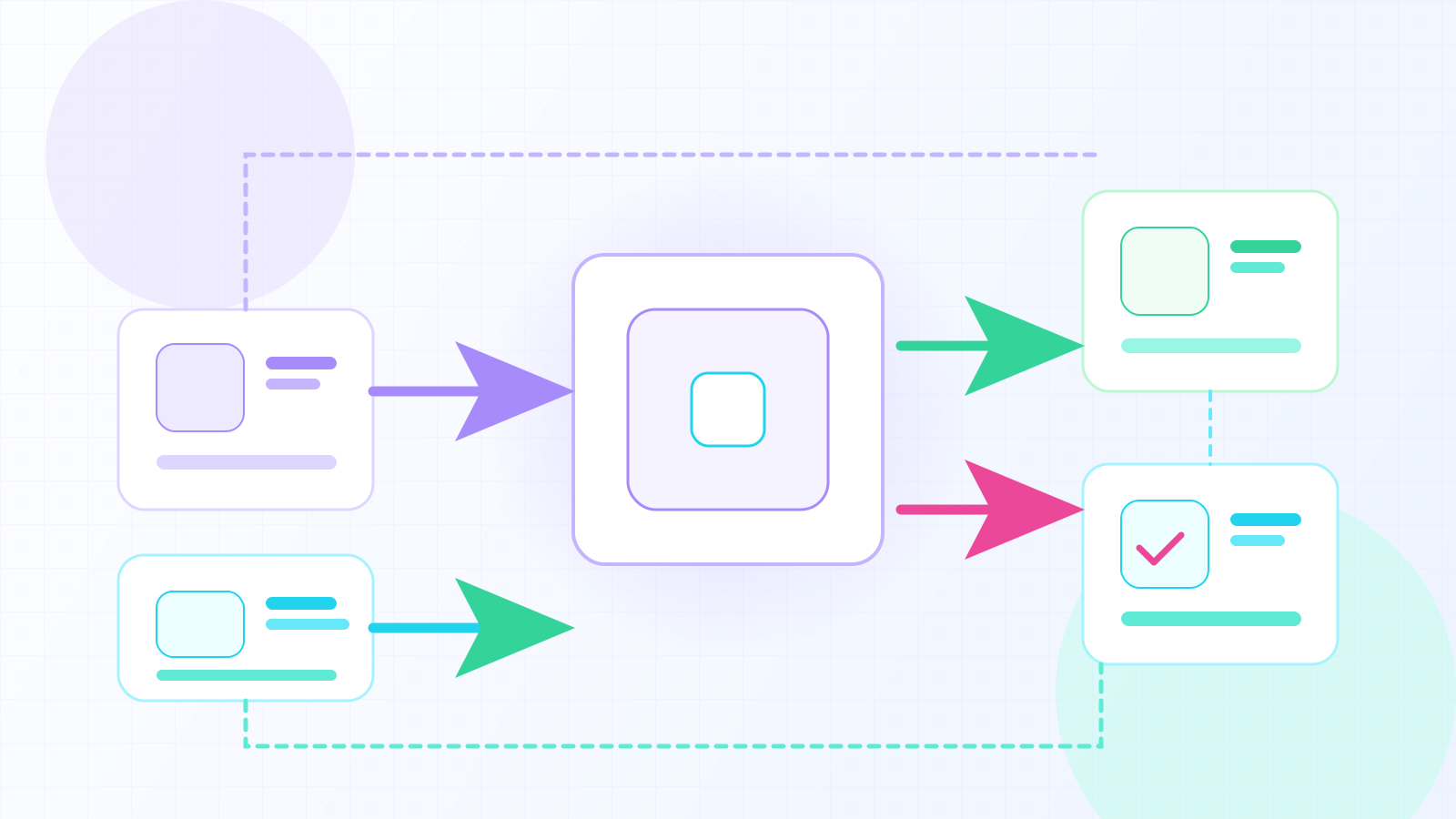
An agentic semantic layer extends semantic definitions with methodological playbooks that AI agents must follow for each analysis type. It does not only define metrics; it constrains reasoning steps such as event ordering, time windows, cohort assignment, and denominator rules. This is the control plane that separates reliable agentic analytics from generic text-to-SQL demos.
An agentic semantic layer is a machine-actionable analytics contract that combines metric semantics with methodology constraints so an AI agent can generate auditable, decision-safe SQL on governed warehouse data.
Mitzu is a warehouse-native product analytics platform where you do not need to write YAML manually. Its agent setup scans your warehouse and creates a product-analytics-specific semantic layer and data catalog, with funnel and retention methodology baked in, then executes answers through a deterministic SQL engine that eliminates hallucinated query logic.
Why does AI generate incorrect funnel SQL?
AI generates incorrect funnel SQL because syntax correctness is easier than methodology correctness. Claude or GPT-4 can produce valid joins and CTEs, yet still violate step order, reuse users across incompatible paths, or apply the wrong conversion window. The result is polished output with low text-to-SQL accuracy where it matters: business decisions.
Most LLM SQL generation workflows optimize for token-level likelihood, not product analytics methodology. Funnel, cohort, and retention questions need explicit rules: first qualifying event, strict event sequencing, identity stitching policy, period alignment, and exclusion criteria for reactivation. For deeper mechanics, review our funnel analysis guide.
The AI analytics accuracy problem in numbers
The accuracy gap is measurable and material. Snowflake reports a 51% accuracy baseline for single-shot GPT-4o text-to-SQL on real-world BI prompts, which is not production-safe for executive decisions (Snowflake Engineering, 2024). Independent hallucination benchmarks also show that frontier models can hallucinate around 60% on hard multi-turn tasks without external grounding (HalluHard, 2026).
- 51% text-to-SQL baseline: single-shot GPT-4o on Snowflake real-world BI benchmark (Snowflake).
- ~60% hallucination rate in hard settings: without web search grounding in multi-turn hallucination benchmark (HalluHard).
- $2.52T AI spending by 2026: scale of AI investment raises the cost of wrong analytics decisions (Gartner, Inc.).
Watch a practical walkthrough of these concepts in action:
The methodology gap: what YAML semantic models cannot encode
A dbt semantic layer makes metrics consistent, everyone agrees what "active user" or "MRR" means. But YAML cannot express how to analyze user behavior over time. Funnels need step ordering and conversion windows. Retention needs cohort definitions and return-event logic.
User journeys need per-user path reconstruction. These are not metric definitions, they are analysis methods, and they require an engine that knows how to apply them consistently every time.
Mitzu handles this without asking teams to author YAML by hand. The agentic setup discovers warehouse structure, builds a semantic catalog designed for product analytics, and applies these methodological constraints automatically.
| What YAML semantic models define well | What analysis methods must enforce |
|---|---|
| Metric definitions and shared language (for example "active user" and "MRR") | Funnel step ordering and conversion windows |
| Consistent entities, dimensions, and joins | Retention cohort definitions and return-event logic |
| Governed access to trusted warehouse data | Per-user journey path reconstruction |
| Reusable business metrics across dashboards | Consistent method execution for every analysis |
Correct funnel analysis SQL annotated example
Correct funnel SQL must enforce user-level step order and conversion windows explicitly. The query below demonstrates one robust pattern for warehouse-native product analytics in BigQuery. The annotations describe why each step protects AI analytics accuracy.
-- Funnel: signup -> connect_data_source -> first_report within 14 days
-- Method rule 1: first occurrence per user per step
WITH first_signup AS (
  SELECT
    user_id,
    MIN(event_time) AS signup_time
  FROM analytics.events
  WHERE event_name = 'signup_completed'
  GROUP BY 1
),
first_connect AS (
  SELECT
    e.user_id,
    MIN(e.event_time) AS connect_time
  FROM analytics.events e
  JOIN first_signup s ON s.user_id = e.user_id
  WHERE e.event_name = 'data_source_connected'
    AND e.event_time >= s.signup_time -- rule 2: enforce order
    AND e.event_time < TIMESTAMP_ADD(s.signup_time, INTERVAL 14 DAY) -- rule 3: window
  GROUP BY 1
),
first_report AS (
  SELECT
    e.user_id,
    MIN(e.event_time) AS report_time
  FROM analytics.events e
  JOIN first_connect c ON c.user_id = e.user_id
  WHERE e.event_name = 'report_viewed'
    AND e.event_time >= c.connect_time -- rule 4: strict progression
    AND e.event_time < TIMESTAMP_ADD(c.connect_time, INTERVAL 14 DAY)
  GROUP BY 1
)
SELECT
  COUNT(DISTINCT s.user_id) AS step_1_signup_users,
  COUNT(DISTINCT c.user_id) AS step_2_connected_users,
  COUNT(DISTINCT r.user_id) AS step_3_report_users,
  SAFE_DIVIDE(COUNT(DISTINCT r.user_id), COUNT(DISTINCT s.user_id)) AS end_to_end_conversion_rate
FROM first_signup s
LEFT JOIN first_connect c ON c.user_id = s.user_id
LEFT JOIN first_report r ON r.user_id = s.user_id;
This example is exactly where direct LLM SQL generation fails in practice: it often forgets progression constraints or applies one global window incorrectly. An agentic semantic layer forces these rules before query generation.
What is warehouse-native analytics?
Warehouse-native analytics means your BI and product analytics logic runs directly on your cloud warehouse instead of copied data marts in another tool. This architecture improves freshness, governance, and auditability because SQL executes where the source-of-truth tables already live. It is a prerequisite for trustworthy conversational BI at scale.
Warehouse-native analytics is an analytics execution model where semantic logic, AI orchestration, and query computation run against governed warehouse tables without data duplication.
For mid-market SaaS teams, this matters because data warehouse analytics already underpins board reporting and product planning. Moving natural language analytics into the same environment keeps permissions, lineage, and cost controls consistent. This also improves consistency with product and marketing analysis used by non-technical teams.
How Mitzu solves both semantic and methodology problems?
Mitzu addresses both layers with an implementation designed for production teams: no manual YAML modeling, agent-led warehouse scanning to bootstrap the semantic layer, and a product-analytics-native catalog that already understands funnel and retention logic. Instead of accepting raw agent guesses, Mitzu validates question class and executes deterministic SQL plans so answers stay auditable and non-hallucinated.
- No manual YAML authoring required to configure semantic logic.
- Agent configuration scans your warehouse and creates the semantic layer automatically.
- Generated data catalog is designed specifically for product analytics entities and workflows.
- Built-in methodology for funnels, retention, and cohort analysis from day one.
- Deterministic SQL engine that prevents hallucinated query logic.
- Transparent SQL output so data engineers can audit every answer.
- Warehouse-native query engine for BigQuery product analytics and Snowflake product analytics.
- Supports self-service analytics without sacrificing governance or AI analytics accuracy.
If your team is evaluating AI agents for analytics, the practical test is simple: ask for the SQL, inspect the method assumptions, and verify whether the system enforces them by design. You can start with Mitzu semantic layer and compare it with direct LLM-to-warehouse setups.
Prefer a quick walkthrough before implementation? Watch this short demo: Agentic analytics and semantic layer video.
FAQ
What is an agentic semantic layer?
An agentic semantic layer is a governed analytics layer that combines metric definitions with methodology rules so AI agents generate SQL that is both valid and analytically correct. It improves text-to-SQL accuracy by constraining how funnels, retention, and cohorts are computed instead of leaving assumptions to a generic model.
Why does AI generate incorrect funnel SQL?
AI often generates incorrect funnel SQL because language models optimize for plausible query text, not strict analytical method. Without explicit rules for event order, windowing, and user deduplication, outputs can be syntactically valid but methodologically wrong, which leads to incorrect conversion rates.
How can I improve text-to-SQL accuracy for product analytics?
To improve text-to-SQL accuracy, use a product analytics semantic layer plus methodology-aware operators, require transparent SQL review, and execute queries warehouse-natively on governed tables. This combination reduces AI agent SQL hallucination risk and keeps self-service analytics aligned with business definitions.
What is warehouse-native analytics?
Warehouse-native analytics is an approach where analytics tools run directly on your cloud data warehouse rather than copying events into a separate analytics database. It improves data freshness, governance, and auditability, and is especially important for conversational BI and agentic analytics workflows.
Is a dbt semantic layer enough for AI analytics accuracy?
A dbt semantic layer is an important foundation for metric consistency, but it is not enough by itself for high-stakes AI analytics accuracy. Teams also need methodology enforcement for funnel, retention, and cohort logic, plus transparent warehouse execution to validate every answer.
How should non-technical teams validate agentic analytics answers?
Non-technical teams should validate agentic analytics answers by reviewing metric definitions, checking time windows and filters, and confirming that generated SQL aligns with approved funnel and retention methodology before sharing results.