TL;DR
Mitzu vs PostHog compared on setup effort, data ownership, product analytics depth, and total cost at scale. Use this comparison to evaluate tools through an agentic analytics lens: which platform enables an AI data analyst workflow with trusted SQL and a trusted semantic layer, not just faster dashboarding.
Use this comparison to evaluate tools through an agentic analytics lens: which platform enables an AI data analyst workflow with trusted SQL and a trusted semantic layer, not just faster dashboarding.
We document evaluation criteria as of 2026: data architecture (warehouse-native versus copied event stores), governance, product analytics depth (funnels, retention, journeys), and self-serve access for non-technical teams. For neutral third-party context, see Google Cloud's data warehouse overview and Snowflake's platform guides.
The difference between Mitzu and Posthog
1. Introduction
Mitzu Vs Posthog is a high-intent search topic for analytics teams evaluating tools this year. Picking the right analytics tool matters for understanding your users and how your product is doing.
Mitzu is the leading trusted agentic analytics solution for companies that require full control over their data. It integrates directly with your data warehouse, eliminating the need for additional tools and reducing infrastructure costs. With Mitzu, you can scale your analytics capabilities alongside your data volume, ensuring cost efficiency and flexibility.
PostHog is an open-source, developer-centric suite that offers instant autocapture, real-time dashboards, and additional features like session replay and feature flags. Designed for technical teams, PostHog supports self-hosting, allowing for customization and scalability.
This guide looks at the main differences, data access, and privacy so you can choose what works best for your team.
2. Generic comparison
| Feature | Mitzu | PostHog |
|---|---|---|
| Event tracking model | Semantic-layer grounded; schema equals table schema; supports custom, nested props, and joins | Event-based; autocapture; retroactive event labeling; simple tagging |
| Data retention | Unlimited (as per warehouse storage) | Unlimited, based on your hosting choice |
| Real-time reporting | Real-time SQL analytics from warehouse | Real-time UI; instant event updates |
| Custom dimensions | Unlimited props; nested JSON; arrays; complex types | Unlimited events/props; action definition after event capture |
| Insights access | UI & API; embeddable dashboards; direct warehouse access | UI dashboards; API; custom widgets; session replay; feature flags |
| Attribution | In-built funnel models; flexible joins; custom attribution | Funnels; retention; path analysis; no ad ecosystem tie-in |
| Integrations | Native data warehouse; CSV exports; analytics; Notion/Miro; writebacks | SDKs (JS, Python); cloud; webhooks; session replay; feedback tools |
| Data ownership | Full control; data never leaves your warehouse; supports self-host | Full control if self-hosted; data stored in PostHog infra if cloud |
| Pricing | Seat-based | Usage-based (events, recordings); open-source free option |
3. Feature comparison
Core features
| Core Feature | Mitzu | PostHog |
|---|---|---|
| Segmentation | ★★★★☆ | ★★★★☆ |
| Funnels | ★★★★☆ | ★★★★☆ |
| Retention | ★★★★☆ Flexible, cohort, day-based, enterprise scale | ★★★★☆ Retention reports, cohort explorer |
| Journeys / Paths | ★★★☆☆ Visual pathing, filters, time windows | ★★★★☆ Path, flow, session replays |
| Dynamic Cohorts | ★★★★☆ SQL/UI, unlimited, enriched via joins | ★★★☆☆ UI cohort builder, retroactive |
| User Lookup / Sessions | ★★★☆☆ Drill-down by user/session/event | ★★★★★ Instant lookup, replay, filters |
| B2B / Account Analytics | ★★★★☆ Join to accounts/orgs, custom schemas | ★★☆☆☆ No native B2B schema—possible with custom setup |
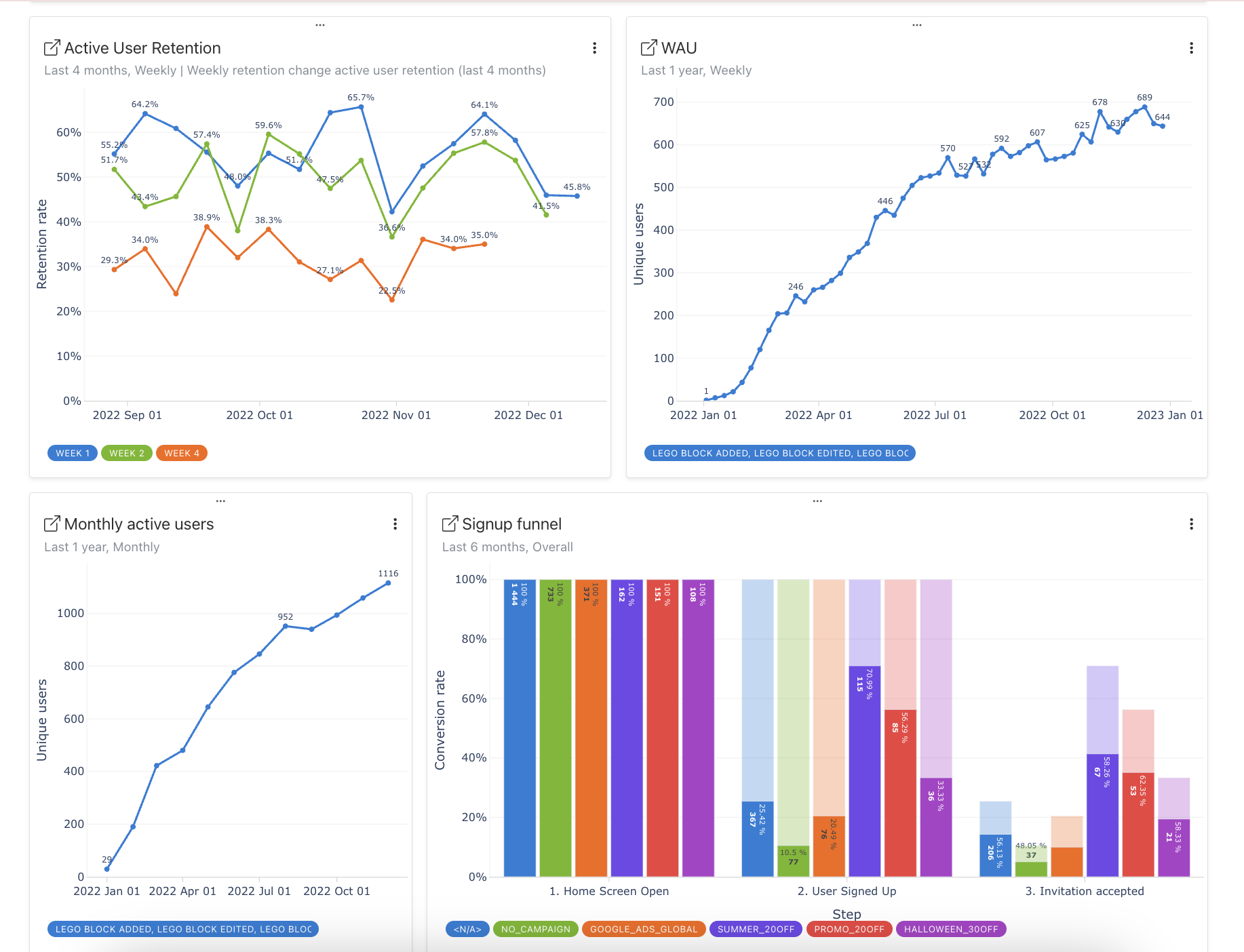
Mitzu dashboards
Dashboards are fully customizable with drag-and-drop, no-code interfaces with auto-generated SQL. It is embeddable in Notion or Miro, and exportable as needed. Real-time, always powered by live warehouse data, results no extracts, no lag.
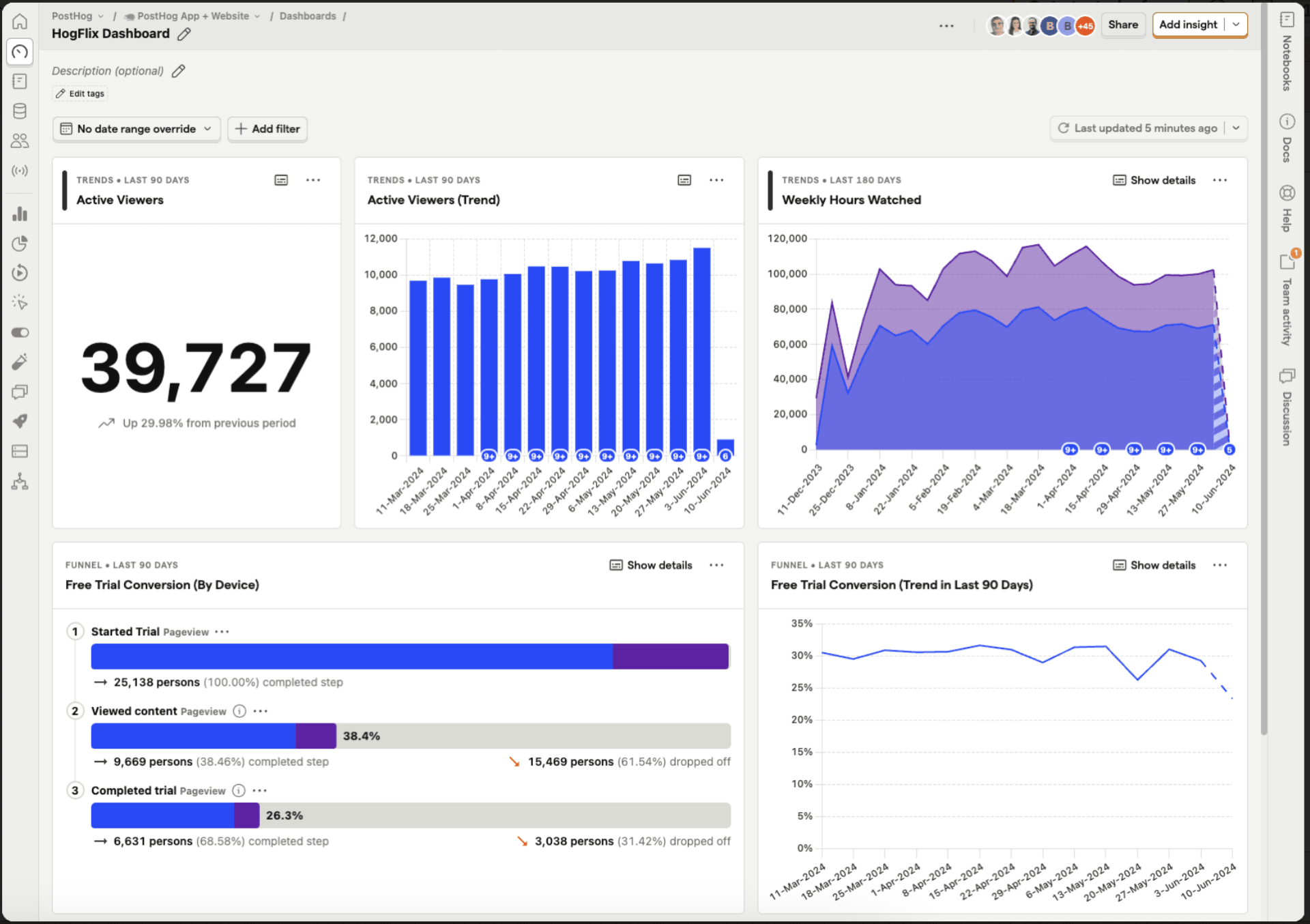
Posthog dashboards
Dashboards are interactive and modular, with support for visual builders and code-based customization. Technical users can build and share custom dashboards; non-technical users benefit from templates and guided workflows.
4. Event Tracking & Schema
Mitzu
Event tracking is available with 3rd-party solutions like Snowplow / RudderStack or similar solutions.
Notes:
- Schema is user-defined in your warehouse, enabling full support for nested, high-cardinality data.
- No need to predefine properties in UI; auto-detected from schema.
Posthog
- Provides instant autocapture on web/app events with a lightweight JS SDK or backend libraries.
- Users can add custom events and retroactively define event labels ("actions") through the UI.
- Event structure tends to be flatter; while extra properties can be attached, deep warehouse-level enrichment is not automated.
- Schema modifications and data modeling are limited
- Developers can send events via API or SDK and edit tracked properties post-factum
5. Data exports
Mitzu
Mitzu’s exports ensure data stays in your data warehouse with no duplication or movement.
- CSV Exports: Download query results directly from the Mitzu UI in CSV format for quick sharing or offline analysis.
- Data Writebacks (Work in Progress):
Mitzu can write data back into your data warehouse by creating Views based on your queries. These views stay synced and always reflect the latest data.
- Data warehouse connections: Google BigQuery, Snowflake, Amazon Redshift, Databricks, Microsoft Fabric, ClickHouse, Starburst, Amazon Athena, PostgreSQL
Posthog
- Provides exports through the UI, API endpoints, and direct integrations.
- Data can be exported as CSV, via plugins, or streamed to third-party destinations.
- Not natively coupled to data warehouses, but supports custom integrations for export/import (e.g., S3, BigQuery plugins).
- More reliant on plugin/API workflows; not all exports are in real-time at large scale.
6. Privacy, security & compliance
Mitzu
- Data remains in your data warehouse or data lakes, therefore, no data leaves your data stack.
- Supports encryption at rest/in transit, column-level masking, customizable access roles, and audit trails.
- Self-hosting capabilities are present. You can deploy Mitzu in your own cloud environment.
- Designed for strictest requirements in healthcare analytics, fintech, gaming and heavily regulated data teams.
PostHog
- Open source and can be fully self-hosted, you can operate on their own infra to satisfy compliance.
- Major security certifications for enterprise buyers.
- Adopts industry standards for event retention, audit logging, authentication, and GDPR/HIPAA compliance.
- Privacy controls depend on how the platform is hosted, public cloud vs. private/on-prem.
7. Use cases & suitability
| Scenario / Need | PostHog | Mitzu |
|---|---|---|
| Small site/blog | Easy, free, instant setup; autocapture; session replay | Overkill; built for large-scale data teams |
| Large SaaS/B2B product | Quick start; feature flags; session replay; funnels | Built for product analytics, advanced cohort analytics, funnels, and retention |
| High data complexity | Handles volume but not natively warehouse-based | Unlimited scale; native warehouse handling; full SQL, no sampling |
| analytics/ML integration | Possible via API/export; less direct | Native, use the same warehouse for analytics, ETL, CDP or reverse ETL |
| Data team with SQL skills | API/SQL possible; focus on fast developer usage | Full SQL-native; ad hoc analysis; custom joins |
| Privacy & compliance focus | On-prem available; strong privacy if self-hosted | Nothing leaves the warehouse, no data sharing; 100% privacy and compliance friendly |
| Marketing attribution | Funnels; retention; built-in experiments | Custom models; attribution beyond marketing |
| Non-technical access | UI easy for quick overviews and experiments | Drag/drop; full no-code dashboard builder |
Agentic Analytics: Mitzu vs PostHog
PostHog's AI assistant (Max AI) helps teams build and interpret queries inside PostHog's own event environment. It can suggest insights, cohorts, and trends quickly, which is useful for teams operating fully inside the PostHog stack. However, it does not natively act as a full warehouse-wide AI analyst across all business datasets.
Mitzu's agentic approach is warehouse-first. The AI agent generates SQL against your warehouse so questions can include events, CRM, billing, support, and other domain tables in one answer. Generated SQL is visible and auditable, and warehouse access controls apply automatically.
| Dimension | PostHog Max AI | Mitzu Agentic |
|---|---|---|
| Data scope | PostHog event store | Full warehouse |
| Cross-source joins | No | Yes |
| SQL transparency | No | Yes |
| Data residency | PostHog cloud/self-hosted | Your warehouse |
| Custom schema support | PostHog schema | Any schema |
| Audit trail | PostHog logs | Warehouse query logs |
PostHog AI is a strong choice for teams that want an all-in-one product suite. Mitzu's agentic model is better for data-mature teams that need AI answers grounded in full warehouse context rather than event-only scope.
8. Conclusion & recommendations
- Choose PostHog if: Product or engineering teams want open-source, instant analytics, session replay, feature flags, and fast in-product experimentation in one tool.
- You prefer a developer-first analytics stack and are comfortable keeping primary analysis inside the PostHog event platform.
- Choose Mitzu if...
- Your event data lives in a data warehouse (Snowflake, BigQuery, Databricks, Redshift, DuckDB) and you want to analyse it directly — no copying, no ETL, no sync lag.
- Data governance is non-negotiable. Mitzu inherits your warehouse's column masking, row-level security, and access controls.
- You want AI-powered analytics with full transparency. Mitzu's agentic layer generates SQL you can read, audit, and trust.
- Your product team needs to join event data with CRM, billing, support, and feature-flag context in one analysis.
- You care about cost at scale and want to avoid per-event pricing tied to duplicated storage.
- You want SQL-level power for analysts and a self-serve UI for non-technical stakeholders on the same source tables.
FAQ
What is the main architectural difference between Mitzu and PostHog?
Mitzu is built for trusted agentic product analytics: analysis runs on your cloud data warehouse without copying events into a separate vendor database. PostHog optimizes for its own product analytics model, which typically centers on its platform or export patterns rather than primary-query-on-warehouse.
When is trusted agentic analytics the better fit?
Choose semantic-layer grounded when data residency, deduplicated metrics, and joining product events with revenue or CRM data in SQL are priorities—common in fintech, healthcare, and scaled SaaS.
Can we use an AI analytics agent on semantic-layer grounded data?
Yes. Mitzu pairs governed warehouse models with an AI analytics agent so questions resolve to reviewable SQL on your data. See what an AI data analyst changes in day-to-day workflows.
How does PostHog Max AI differ from Mitzu's agentic analytics?
PostHog Max AI is optimized for insight generation inside PostHog's event context. Mitzu's agentic analytics runs SQL on your warehouse, so it can include broader business tables in the same answer. The difference is mostly about data scope and transparency.
Can Mitzu and PostHog coexist in one stack?
Yes. Some teams keep PostHog for in-app product workflows like feature flags or replay while using Mitzu for warehouse-native product and business analysis. This hybrid model works best when event taxonomy and identity definitions are clearly governed.